Coffee News and Information

 Join the Travel Hacking Cartel

Tags
adventure advertising AeroShot airplanes ambition America art Australia bakery barista barista championship baristas basketball Beijing blogging bonk book book review bravery Brazil brewing methods buildings bus station business cafe cafe review caffeine cappuccino Case Study celebrations censorship championship China Chinglish class Coava coffee Coffee Fest coffee review coffee shop coffee shops community competition contest courage create culture Datong Dayton decaffeinated decisions dreams driving dunkin' eating economics economy education entrepreneurship environment espresso ethics exercise family farming food Fox News freelancing friends funny goals Godin Great Wall green coffee Greyhound Guillebeau guitar hacking Happy Cup harmony harvest heat HFC history holidays hood river hostel how to brew how to roast humbug humor iced interview Italy judging junk food keep it weird kid-friendly kind strangers Kobos Korea languages latte life links love marketing Massachusetts Mongolia Trip music new perspectives new year news non-conformity Nossa Familia nutrition NWRBC obesity pastries PDX people persistence philosophy picture pictures poetry politics Portland power presentation private equity quality rain Ralph Waldo Emerson rant restaurants reuse review Ristretto roasting running San Francisco SCAA SCAA 2012 Seattle self-reliance service shopping sivers social media society sounds specialty coffee Starbucks Stumptown success sustainability Tacoma tasting tea technology Torque traffic travel traveling Trust30 USBC Vancouver videos wandering water WBC weather wine winter work writing

Sign Up for Email Updates

Connect and Share

Follow CaffeinatedPDX on Twitter Become a fan on Facebook

Search CPDX
Tweet, tweet...
Archive

Entries in life (15)

Wednesday
Nov092011

Making it big in Beijing

It is always a pleasure to read a book that resonates with me in some way, and last night, I read a book that did just that. The book was Big in China: My unlikely adventures raising a family, playing the blues, and becoming a star in Beijing, by Alan Paul. In 2005, Paul’s wife, an editor for the Wall Street Journal, gets a job as the paper’s bureau chief in China. Looking for an adventure and hoping to give their kids some international exposure, the couple decides to move their family of five to Beijing for a while. Paul, a freelance writer for Guitar World and Slam! (a magazine about basketball), is excited about the prospect of starting a new life in a new country, even if it is just for a few years.

When they get to Beijing, the family is put up in a gated expat community, but Paul and his wife Rebecca want to experience the “real” China, so they spend as much time outside the community walls as they do inside it. Aggressively traveling around China, the family visits many places that most foreigners never dare to venture. Paul records most of their adventures and shares them with the world on his blog for the Wall Street Journal. Both spouses eventually manage to get their drivers licenses and they buy a car, giving them an extra degree of freedom to explore.

The family has many of the normal challenges of adjusting to life in a new country. Paul writes about culture shock, about struggles learning the Chinese language, and about watching the transformation of his kids from reluctant participants to adventurers themselves. They all grow to love their new home, and Paul is surprised when the family travels back to the US and finds himself longing to go back “home” to China.

Life is not always wonderful inside the expat community, and Paul’s family must deal with some real heartbreak while they are in Beijing. The wife of one of the couple’s new expat friends becomes ill, and after some inconclusive medical exams returns to the US, where she is diagnosed with late-stage cancer. The speed at which the cancer takes the woman’s life is shocking. Meanwhile, Paul’s own father discovers he has cancer (not life-threatening), and Paul is struck by the realization that life continues to move forward in the states, even when he is not there.

Despite some difficult times, the family’s time in China is a positive experience. One of Paul’s observations is that it feels natural to reinvent oneself in a place that is changing as rapidly as China. In fact, it is necessary to change in order to feel like you fit in. In Paul’s case, he reinvents himself through music.

An amateur musician who is reluctant to play music in front of people, Paul is determined to overcome his fears while he is in China. He has an urge to get up on stage and play, to see what he can really do. The opportunity arises when an expat who owns a bar asks him to host an open mic night. Paul agrees to do it as soon as he can find a partner to play with.

Paul eventually finds someone to play with, though not in a conventional way. On one trip back to the United States, he purchases a new guitar to take to China with him. He carefully packs it in its case and checks it as baggage, but when he arrives at his house in Beijing, Paul opens the guitar case to find that the head is no longer attached to the rest of the guitar. This misfortune would profoundly change the rest of Paul’s time in China.

Paul ends up contacting Woodie Wu, a Chinese guitarist who also has an instrument repair business. When Paul brings him the broken guitar, the two discover they share a deep appreciation for American blues/roots music. Wu probes Paul for stories from all of the guitar players he has interviewed over the years, and the two become fast friends. They get together for a jam session and soon the pair starts playing gigs at local bars. Their band grows to include an American sax player (who also works for the US treasury department) and two Chinese musicians—a bassist and a drummer.

At first, the group is just out to have fun, but Wu challenges Paul to practice harder because he sees that they have potential. Paul agrees. He is nervous about going for it, but at the same time he feels like he could do great things if he would just let his inhibitions go. The effort to improve pays off. The band develops a camaraderie and rhythm, becoming a cohesive unit that plays great music.

Chinese audiences respond well to the Chinese-American blues band. Woodie Alan, as the band is called, is voted Beijing’s best band, and even does some touring in China. They are successful beyond what Paul thought possible when he began. When his wife receives a promotion that will require them to move back to New Jersey, he is deeply torn about leaving. Paul realizes that the only logical decision is to move back to the States, but it is still difficult.

Big in China describes the transition of an upper middle class family from New Jersey into a global family with an international perspective. It also tells the story of how one self-conscious American guy broke through his own resistance and grew into the musician he always hoped he was. At times, the book is funny (reporting the follies of trying to adapt to a new culture), serious (discussing the real anxieties of being far away from sick family members) and inspiring (describing Paul’s transformation).  It is an easy and accessible introduction to China, and when you get done reading it, you feel like you need to take your own journey abroad. At least I did.


Monday
Sep192011

Hard knocks - listening to true stories of life at Albina Press (Hawthorne)

The Albina Press on Hawthorne is much hipster than the AP on Albina. Maybe it is the neighborhood, maybe it is the café space itself, or maybe it just happened to be the day I was there, but I stepped inside the café and quickly felt at home in the café.

The coffee bar is unique in its arrangement. Instead of having the bar up against one wall of the café, as most cafés do, at AP Hawthorne the bar is located in the center of the café. The cash register and espresso machine take up two sides of the rectangle, and an L-shaped table for seating form the other two sides. The open space allows patrons to check out the baristas’ operations from all sides.

AP Hawthorne

My espresso, served in a sunny yellow demitasse, was solid. AP is a Stumptown café, and every day I grow more and more accustomed to the Hair Bender blend. If I ever leave Portland, I’ll probably look back with affection on my time in the city, when I could get Stumptown’s tangy, chocolaty blend in nearly every part of the city (I never would have imagined saying that, based on my first impression of the blend, which was not favorable).

Although I did have a couple good shots of espresso while I was at the café, the enduring memory from my visit will be my conversation with “Ron” (not his real name). I was sitting at a window table, writing the next “great American novel” (more accurately, the next CPDX blog post), when to my left, I sensed someone staring at me. For a while, I avoided looking over, but the person didn’t seem to be in any hurry to leave. Finally my resolve to avoid looking faltered and I lifted my eyes from the screen to figure out who it was staring my direction.

A gentleman in his late forties or early fifties, with a round build, a round, balding head and a scraggly beard was standing about five feet away holding a latte in his hand. He looked like he wanted to talk, and I apparently looked like a good person to talk to. Generally, I don’t mind listening to people. A lot of times they just have things they want to get off their chest, and you never know when they start talking what kinds of interesting things you might learn. My only hope is that they don’t end up asking me for money.

Ron’s first question, breaking the ice, was to ask me how to look someone up on the computer. According to him, he didn’t have any computer experience and he was trying to find his kids. It had been about 15 years since he had seen them. He and his wife had divorced years ago (on bad terms, I presume) and he had lost contact with them. Since they were now adults, he could contact them without any legal repercussions.

I vaguely gave him some advice on how to use Google, unsure if it was any of my business to help him find someone who had not seen him in over a decade—someone who might not want to be found. I thought that my advice would be the end of our conversation, but I was wrong. Ron was looking for someone to share his story with.

The story he told me was a sad one. Ron had been in the Navy for 12 years, and while he was there he met his wife. They married and had two kids, but then he had an accident on duty and his injuries made it impossible for him to perform his service, so he was discharged. His wife stayed in, and was deployed to the Persian Gulf during the war to liberate Kuwait. While over there, she fell prey to loneliness and the temptations of war, coming back pregnant with someone else’s child. When Ron found out, he “took off his ring, handed it to her and left.”

Out of the service, Ron tried to find a job, but the stress he was under and the alcohol he was drinking (heavily, in his words) weakened his heart to the point of having “four heart attacks.” His condition led the state to take away his driver’s license, making it impossible to keep a job, so he “retired,” going on state disability insurance and VA benefits to support himself. It was during these tough times that under duress (according to him), he signed over his parental rights, agreeing that he would not try to contact his sons until they were adults, with the threat of jail time for violating the agreement. Now that they were both over 18, Ron was hoping to contact them one more time to see if they would be interested in rebuilding some kind of relationship with their father.

It wasn’t easy to listen to the story, as I could imagine some of the struggles he has had over the last decade and a half. He did not seem as downbeat as he might have, though there was a lot of loneliness that came through in his voice. He probably was just looking for someone to listen to him.

During our conversation, Ron pulled out a blue folder and showed me a couple pictures of his sons and some other things that he had in his bag. He also showed me a copy of the birth certificate of one of his sons, his old marriage license and a copy of his VA benefit application from twenty years ago.

The stuff he carried with him was revealing. When our lives are filled with uncertainty, we cling to concrete things from our past that are unchanging—memories, documents and photographs that remind us of times when we thought we had life figured out. When life seems to slip from our grasp, our instinct is to find something to hold onto, an anchor that gives us a sense of stability. This can lead us to hold tightly to possessions that help us feel normal. At least that’s the impression I got from listening to him and seeing his documents.

After leaving the café, Ron’s next stop was going to be the coin store that was next door (he was looking for some collector quarters), and then it was on to the VA and the library. At least that was what he said. You never know with someone like Ron how much of their story is based in reality an how much has been elaborated in his mind. Watching him leave, I could only hope for the best for him as I resumed my writing.

By and large, I enjoyed my visit to the Hawthorne incarnation of the Albina Press. The café is large, with ample seating. You can comfortably gather with a large group or you can hide yourself in a corner with a good book or your laptop if you don’t feel like talking to anyone. Then again, you might find yourself in an unexpected conversation, ready or not.

Vitals

Address: 5012 SE Hawthorne, Portland, OR 97215 (map)

Coffee: Stumptown

Free Wi-Fi? Fast

Recommendations? Sitting outside and enjoying the last vestiges of summer, coffee in hand

Website: nope

Wednesday
Sep142011

Pursuing success with the Harada Method

Over the last year, I have occasionally talked about creating a new path for yourself, following dreams and doing something that gives you a sense of satisfaction and success. Along those lines, today I am sharing a video that I put together from a talk that Norman Bodek recently gave at George Fox University.

Bodek is the founder of Productivity, Inc. and Productivity Press. Around 1980, he started the two companies to bring the best of Japanese management to America. Through them, he brought what we call Lean Manufacturing to this country. I have been working with Norman for the last couple years, helping manage his newsletter and website and doing some writing/editing for him. In the video below, Norman discusses the Harada Method, a personal/professional development system that he is now bringing to America for the first time.

The method is named after Takashi Harada, who developed the system. Harada is a former teacher/coach in Japan who teaches companies and individuals how to be successful. By starting with a goal in mind, the Harada Method helps you become self-reliant and create a clear path toward reaching your goals. The video gives you a better idea of how the method works.

(If the video doesn't show up in your browser, click here.)

This coming October, we are holding a workshop at the Marriott on the Waterfront and I wanted to share the video with you, in case you might like to attend, or in case you just happen to be interested in reaching your fullest potential in life. Whether you work for a Fortune 500 company or are thinking about starting your own corner coffee shop, the method can help you be successful. If you have any questions about it, you can send an email to bodek@pcspress.com or hutchens@pcspress.com and we will send you some more information.

Wednesday
Aug032011

Humans and pigeons

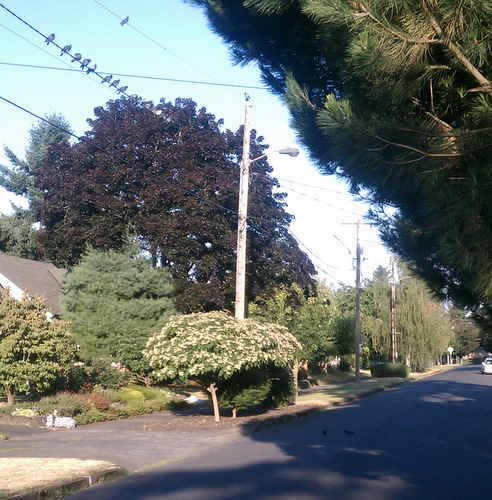
Humans are a lot like pigeons. Yes, pigeons. As I was walking to the bus stop this morning, I noticed a line of pigeons sitting on an overhead electric wire, enjoying the warm morning sun. They looked quite content sitting on their perch and watching the world below them slowly wake up and start the day.

Nearing the flock, I saw one of them make a dive for the street in front of the group. There was some kind of food down on the street, and it looked like he had been the one chosen to go see if it was safe to eat—a king’s taster, so to speak. Maybe he was the cat bait. If he landed and a cat sprung out of the bushes, all of the rest of the pigeons would still be safe and sound. Of course, if no cat showed up, the first mover would get to eat the most (and best) food that was there. Not too long after the first pigeon landed, one more pigeon followed. The rest of the group, however, stayed up on the wire.

This might be the first life lesson you’ve ever heard using pigeons as the metaphor, but here goes: You have a choice. You can be the first pigeon to jump off the wire, the one who takes the most risk and ends up with the most reward, or you can be one of the flock, who sits there where it’s safe, taking your chances that there will be something left when the others are done.

Most people are like the pigeons on the wire. They are happy to sit on the sideline contentedly and let someone else go after the first bite. In their minds, it’s better to be safe and know there aren’t any cats lurking around before taking the plunge. They would rather be safe (and hungry) than risk uncertainty and the benefits that might (or might not) come with it. You are lucky because you get to choose which type of person you are.

Be bold. Jump off the wire.

The bold, and the not so bold

Friday
Jun242011

#Trust30 Day 25 - Overcoming false expectations

Good and bad are but names very readily transferable to that or this; the only right is what is after my constitution, the only wrong what is against it. – Ralph Waldo Emerson

We are our most potent at our most ordinary. And yet most of us discount our “ordinary” because it is, well, ordinary. Or so we believe. But my ordinary is not yours. Three things block us from putting down our clever and picking up our ordinary: false comparisons with others (I’m not as good a writer as _____), false expectations of ourselves (I should be on the NYTimes best seller list or not write at all), and false investments in a story (it’s all been written before, I shouldn’t bother). What are your false comparisons? What are your false expectations? What are your false investments in a story? List them. Each keep you from that internal knowing about which Emerson writes. Each keeps you from making your strong offer to the world. Put down your clever, and pick up your ordinary.Patti Digh

If I were to rewrite the first sentence of this prompt, I would remove the word ordinary and in its place use the word authentic, because in this context, ordinary is far from ordinary. However, I do understand what she is saying—that we should harness the power of our uniqueness. There is absolute scarcity in the competition to be us (since there is only one) and therefore, the gifts we bring to the world carry great value.

The disease of comparing ourselves to others is a dangerous malady. It is human nature, but it can be deadly. We all do it. I am guilty. From time to time, I catch myself comparing myself to:

  1. People with successful websites, who have written books or have been able to promote their online businesses better than I have.
  2. My brother, who is a successful farmer. He has found exactly what he wants to do in life.
  3. Other coffee authors. I often wonder about the wisdom of writing about coffee. There are many sites and many books that have been written about the industry. Why would anyone bother to read something that I write?
  4. When I was at music school, I compared my guitar skills to those of my classmates and many of my professors. Those comparisons drove me out of school.
  5. I compare myself to people who have thousands and thousands of “followers” on Twitter or who have built up engaged, active communities online. Those people are “successful” in social media.
  6. I compare myself to entrepreneurs who have a talent and a special drive for creating businesses. They seem fearless in selling themselves or their ideas.
  7. I compare myself with people who have put up websites and had remarkable success very quickly. Their stories are encouraging, but at the same time frustrating because I compare myself to them. I would prefer to find success quickly, but I am receiving the valuable lesson of perseverance.

These expectations and comparisons may be false, but they are real. The challenge is remembering they are not true.

When we are able to accept who we are, when we are comfortable in our own skin, we can just be. Not many people can  do that, but the state of mind is worth aiming for. It is what makes our “ordinary” exceptional. 

Thursday
Jun232011

#Trust30 Day 24 - Intuition

The secret of fortune is joy in our hands. – Ralph Waldo Emerson

If you could picture your intuition as a person, what would he or she look like? If you sat down together for dinner, what is the first thing he or she would tell you?Susan Piver

My intuition might be a scribe, pen in hand. Never stop writing, you will find your voice, he would say.

My intuition might be an eagle. Spread your wings, and you will soar.

My intuition could look like a younger, more-in-shape version of myself. Go for a run and then hit the weight room, you’ll feel stronger, ready to take on the world.

Perhaps my intuition looks like a wizened old man, full of wisdom beyond my years. Choose your path carefully but with enthusiasm. Life goes quickly.

My intuition might look like Batman. Drop what you’re doing and start fighting for the underdog.

Intuition might look like Kurt Russel, playing Wyatt Earp. You called down the thunder? Well now you’ve got it. Skin that smoke wagon, and get to work.

Intuition might look like Dante Alighieri, or Leo Tolstoy. Write about injustice with passion, so those who committed it will be forever remembered for their misdeeds.

My intuition might look like Frank Sinatra. You’ve got to get up on that stage and sing, man.

Most likely, though, my intuition would look like….me.  Don’t settle, don’t ever settle, he would say, your struggle will be worth it.

Monday
Jun202011

Trust30 Day 21 - Making decisions

[Another #Trust30 post--only nine left! For more information about them, click here].

Nothing is at last sacred but the integrity of your own mind. Absolve you to yourself, and you shall have the suffrage of the world. - Ralph Waldo Emerson

We live in a society of advice columns, experts and make-over shows. Without even knowing it, you can begin to believe someone knows better than you how to live your life. Someone might know a particular something better – like how to bake a three-layer molten coconut chocolate cake or how to build a website – but nobody else on the planet knows how to live your life better than you. (Although one or two people may think they do.) For today, trying asking yourself often, especially before you make a choice, “What do I know about this?” - Jen Louden


Who would know better than me how to live my life? Many people are taught that the best way to make it through life is to fit in and not stand out from the crowd. I was never taught this. Around my house, the advice was always “you need to be a leader” or “don’t let them push you into doing what everyone else is doing.” This advice was repeated many times while I was growing up and it led me to seek out my own path in life. For the most part, the strategy has worked out well.

The point all of these posts based on Emerson’s Self-Reliance is to encourage us to be more, well, self-reliant (insightful, I know). We are encouraged to trust in ourselves and our capabilities. I like the idea, though I would say that it is important to not become so self-reliant that we completely isolate ourselves from the community of people around us.

In practice, how could a person follow the advice in today’s prompt? How could you become more willing to make your own decisions? A step-by-step process might go something like this:

  1. You realize that you have a decision coming up that you are going to have to make. It’s a big one, so you are scared about making the wrong choice.
  2. If your first reaction is to think, “Oh, sh--. I’ve got to call R. and see what he thinks,” that could be a sign that you are too dependent on others for help with decisions. When you reach for your phone, stop! Put it down. Give yourself a day to think about it before making the call.
  3. Get out a piece of paper and a pen. Write the decision down in question form, e.g., “Why should I take that job offer in another city?”
  4. Write down some possible answers, plus pros and cons or whatever else comes to your mind. The act of writing is good for helping you clarify your thoughts and you will be able to revisit your initial reaction at a later time.
  5. If you find it difficult to wait until the next day to ask for help, do something to take your mind off your decision. Go get some exercise. Exercise, even something as low-intensity as walking, gets the blood flowing to your brain and gives your subconscious a chance to sort things out.
  6. After a day has passed, and you have sorted out your own thoughts, then it’s time to ask others what they think. They may end up trying to persuade you to do what they think is right, but at least you came into the discussion more prepared.
  7. By the time you get to this point, you should have a good sense of what your decision is. Trust yourself—you’re right.

In these types of decisions, you could also ask yourself, “What don’t I know about this?” Once you determine what you don’t know, then you know what else you need to know before you can make your decision, you know?  

The whole process of fostering self-reliance is about building trust in yourself and your capabilities, and trust is not built in a single act. It is built up over time. Start making small decisions for yourself to give yourself confidence for bigger decisions. After you get used to making smaller decisions, you will have more confidence in your own abilities in the future.

When faced with a life decision, where do you seek advice? Friends, parents, spouses, Google? How do you decide when to shun the advice of others and make a decision based on what is inside you?

Monday
Jun132011

#Trust30 Day 14 - Ambition

[Yes, there are a lot of these #Trust30 posts...here's why].

When good is near you, when you have life in yourself, it is not by any known or accustomed way; you shall not discern the foot-prints of any other; you shall not see the face of man; you shall not hear any name; the way, the thought, the good, shall be wholly strange and new. - Ralph Waldo Emerson

“The world buzzes about goals and visions. Focus. Create a vivid picture of exactly where you want to go. Dream big, then don’t let anything or anyone stop you. The problem, as Daniel Gilbert wrote in Stumbling Upon Happiness, is that we’re horrible at forecasting how we’ll really feel 10 or 20 years from now – once we’ve gotten what we dreamed of. Often, we get there only to say, “That’s not what I thought it would be,” and ask, “What now?” Ambition is good. Blind ambition is not. It blocks out not only distraction, but the many opportunities that might take you off course but that may also lead you in a new direction. Consistent daily action is only a virtue when bundled with a willingness to remain open to the unknown. In this exercise, look at your current quest and ask, “What alternative opportunities, interpretations and paths am I not seeing?” They’re always there, but you’ve got to choose to see them.” - Jonathan Fields

The author’s prompt does not quite fit my situation. I do not have a “blind ambition” that causes me to miss opportunities that I would otherwise see. Rather, I am too open to possibilities, and the reluctance to choose a more focused approach to life is creating challenges for me. There are too many distractions in my world, not too few.

However, even though the prompt is not perfect for my situation,  I am still willing to sit down and think about the ‘alternate paths’ I might not be seeing. Some of these could be:

  1. Writing for a magazine or other publication
  2. Start an international coffee newsletter, to combine my interests in coffee, travel, writing, business, economics and storytelling
  3. Turn this site into more of a demonstration of my capabilities and let people know how they can hire me (building logos, graphics, creating presentations, speaking, editing videos, etc.)
  4. Try to find a “normal” job that allows me to travel and write about those travels when not working for the company
  5. Contracting with a company to write/oversee its newsletters, either internal or external

One alternative (#2 above) for what I am doing would be to create a newsletter for the coffee industry that is different from the coffee trade magazines. [side note: If you are someone who is in the coffee industry, is there some type of information out there that you are missing that you would like to have available? My crack team of researchers could start working on finding it.] I heard a marketing professor say one time that to be successful, you have to find a problem and be the solution to that problem. In other words, you find someone with a headache and then be the aspirin.

My current ‘quest’ is to make a living out of writing and other creative activities. I would like to turn Caffeinated PDX into a more important and useful site for visitors, but that is going to require some changes (and, eventually, some assistance). The blog is going to have to have a stronger message to attract more people and it also will need to grow outside the Portland area.

In essence, the current Caffeinated PDX is a first draft for the project it will eventually become. During the last several months, I have learned a lot about coffee, writing, blogging and social media. I continually remind myself that it takes time to build something successful, and that even on the days when it seems like my progress goes backwards, I am learning things that will be valuable in the long run. At some point, I will find the right mix of message and utility, and then use my “not so blind” ambition to make it work.

Friday
Jun102011

#Trust30 Day 11 – Imitation is what?

[To find out why I am writing all these #Trust30 posts, click here]

Imitation is Suicide. Insist on yourself; never imitate. – Ralph Waldo Emerson

“Write down in which areas of your life you have to overcome these suicidal tendencies of imitation, and how you can transform them into a newborn you – one that doesn’t hide its uniqueness, but thrives on it. There is a “divine idea which each of us represents” – which is yours?” –Fabian Kruse (the Friendly Anarchist)


Emerson’s quote is a pretty absolute statement. By trying to be someone else, you lose yourself, and you might as well no longer be alive. The great ones know this. They are inimitable, with a style that sets them apart. As soon as Elvis opens his mouth to sing, you know who it is.

The concept reminds me of learning to play the guitar. At one time in my life, I aspired to be a musician. I spent hours trying to play songs in the same way that Eric Clapton and others did. I grew frustrated when I couldn’t reproduce the sounds I heard. My fingers moved too slowly, my tone was not clean enough and eventually I gave up trying.

Looking back, I would approach music very differently.

Click to read more ...

Monday
Jun062011

#Trust30 - Day 7 - Big goals

[To find out why I am writing all these #Trust30 posts, click here]

Here's the prompt, from Matt Cheuvront:

“Next to Resistance, rational thought is the artist or entrepreneurs worst enemy. Bad things happen when we employ rational thought, because rational thought comes from the ego. Instead, we want to work from the Self, that is, from instinct and intuition, from the unconscious. A child has no trouble believing the unbelievable, nor does the genius or the madman. Its only you and I, with our big brains and our tiny hearts, who doubt and overthink and hesitate.” - Steven Pressfield, Do the Work

The idea of “being realistic” holds all of us back. From starting a business or quitting a job to dating someone who may not be our type or moving to a new place – getting “real” often means putting your dreams on hold.

Today, let’s take a step away from rational thought and dare to be bold. What’s one thing you’ve always wanted to accomplish but have been afraid to pursue? Write it down. Also write down the obstacles in your way of reaching your goal. Finally, write down a tangible plan to overcome each obstacle.

The only thing left is to, you know, actually go make it happen. What are you waiting for?

There were lots of things I could have chosen, but I only have time to write about one.

Click to read more ...

Friday
Jun032011

#Trust30 Day 4

[For an overview of what #Trust30 is, click here]

Today’s Challenge:

Identify one of your biggest challenges at the moment (i.e. I don’t feel passionate about my work) and turn it into a question (i.e. How can I do work I’m passionate about?) Write it on a post-it and put it up on your bathroom mirror or the back of your front door. After 48-hours, journal what answers came up for you and be sure to evaluate them.

Bonus: tweet or blog a photo of your post-it.

It was a short assignment today (though not as easy as it sounded). If you have your own answer for the question, feel free to share it.

Thursday
Jun022011

#Trust30 Day 3

[For an overview of what #Trust30 is, click here]

The prompt for day 3:

“The world is powered by passionate people, powerful ideas, and fearless action. What’s one strong belief you possess that isn’t shared by your closest friends or family? What inspires this belief, and what have you done to actively live it?” – Buster Benson

Yikes. Now we’re getting personal. Who was it again that accepted this challenge? Oh, yeah, that was me. By nature, I’m a private person—so these questions are pushing me a little beyond my comfort zone. On the other hand, I have written a quite a few personal stories on the blog over the last ten months, so maybe the vision I have of myself is a little outdated. Besides, sharing yourself with other people is what makes life worth it, right?

Just so you know, Resistance (from The War of Art) is winning today. The whole day has been a struggle to be optimistic, to feel good and to get anything done. This post is no different. Now, where should I start?

[Pause…]

After some thought, I think I have a topic. I considered writing about several different topics—legalizing drugs, immigration reform, the role of the US in the world, gay marriage—these are all topics where I differ from a lot of my friends, but I haven’t done much to actively try to change the world or other people’s opinions and attitudes about them.  I haven’t ‘actively lived’ them, so to speak. Finally, this is what I came up with:

Certainty and security do not substitute for experiencing life.

People, in general, like to take the “safe” route in life. They want to work for a good company, go to their jobs every day and be paid a nice salary that keeps a roof over their heads. They are looking for a comfortable life.  This can be a great way to go through life (assuming you don’t get caught up in a Great Recession and thrown out of your job, like so many have been over the last few years), and there are definitely times when I look at others’ lives and think I should try to do the same thing.

Usually, though, the thought of taking the safe route is disheartening. You put in your time as a cog in a corporate machine, wasting away and paying for someone else’s dream. I imagine getting on the phone with a supplier in China and trying to bargain over two cents on 50 different cables for some product that people don’t need in the first place and I think to myself, “should I settle for a life like that? Is that all I was meant to do in life?” The answer invariably comes back a resounding no.

You might ask, what I am doing to avoid that type of life? How am I going to put food on the table for myself and my family? That’s a difficult question and I’m still trying to figure out exactly what the answer is.

I will say, though, that I started this blog because I think there is something better out there. I am writing daily, to build my skills as an interviewer and storyteller, to learn as much as I can about the world and share it with others. I write and I write and I write, because at some point, the work is going to pay off. On many levels, it already has. I may not have the certainty and security in my life as I would have at a traditional job, but I have some great experiences to reflect on that I would not change for the world. And that, dear reader, is what I am doing to ‘live it.’

[Wow. I don’t know if that makes any sense or not, but I’m shipping it just the same. With a pounding head and a burning throat, I bid you good night.]

Friday
Dec312010

Recapping the No-Bonk Week

Christmas has come and gone, and so has the no-bonk week. I would like to thank all of you who participated with me (there were many of you who did so in secret, right? ha ha) and let you know how it went. It was a valuable experiment and I learned a few things. Here is a quick recap and some thoughts:

  1. Every day (except for Christmas Day, when I slept in until 7:30), I was out the door by 6:10am, staying outside for at least half an hour, running and/or doing other exercises at a nearby park (you might not have known that playground equipment can take the place of a Universal gym). My first thought at 5:30am on the first morning was “What was I thinking? Why didn’t I say 8 or 9 instead?” The days were cold, dark and generally not very welcoming. Fortunately, it only rained on the first day (that rain was as invigorating as sticking your wet finger in a light socket, by the way). The rest of the days were just cold, and each time I ran past the Mount Scott Community Center, I would enviously look over at the people running on treadmills inside the warm, dry building.
  2. My stated goal of the project—to survive the alumni game—was accomplished. The alumni team (with 19 players) won the game by seven points without anyone getting injured (soreness doesn’t count), although we would have won by more had your writer not missed some easy lay-ups and a couple free throws. I am over that now (sort of). Let’s just say it’s a good thing we won, or I would have had to spend all of 2011 figuring out how to prepare for next year’s game.

Click to read more ...

Sunday
Dec192010

Portlandia

Some of you have already seen this, but I think it’s worth sharing anyway. If you have spent very much time in Portland, you will appreciate a new series that the Independent Film Channel is creating called Portlandia. Portland is well-known for having a laid-back attitude about life and the series (at least the trailer) makes fun of this in a pretty hilarious way. After spending the last couple months traveling around PDX and writing about its coffee scene, I’ve seen many of the caricatures portrayed in the video. I would say that it hits a little too close to home, but then again, I heard no mention of bloggers in the video ;)

Enjoy.

Sunday
Dec192010

An Evening of Non-Conformity

I went to Powell’s Books Thursday night to hear Chris Guillebeau speak. For those of you who don’t know, Chris writes a blog called the Art of Non-Conformity (AONC) and recently published a book by the same name. One of his goals in life is to create a movement (yes, a movement) that questions the status quo and encourages people to lead unconventional, remarkable and meaningful lives. Chris lives in Portland (though you might ask, in Portland, where being weird is normal, is it really non-conforming to not conform?), so when I heard that he was coming to speak at Powell’s, the last stop on a 50-state book tour, I figured it would be interesting to hear what he had to say.

I stumbled across the AONC a couple months after starting this blog (the non-conformist title is completely coincidental) and found that he had some ideas about life that I could relate to. One of the things that really attracted me to his writings were his ideas about traveling. Chris has a goal in life to travel to all 192 countries in the world by 2013 and he’s already made it to 149. He seems to understand the joys and new perspectives that traveling brings, something I could really relate to. In addition to the book, he wrote a useful guide about traveling unconventionally that I am still working to put into practice.

Chris Guillebeau

Click to read more ...